
How to build your Connecticut wedding photographer timeline
Build your Connecticut wedding photographer timeline around the ceremony, travel between locations, and the photographs that matter most to you, then leave space between those commitments instead of scheduling everything back-to-back. For your 2026 wedding, confirm church and venue requirements before setting portrait times, and protect the part of the day when the two of you get married with your closest family watching.
TL;DR
- Build your Connecticut wedding photographer timeline around ceremony requirements, travel, family portraits, and time together.
- Choose a first look or aisle reveal before placing couple portraits in your wedding day schedule.
- Ephemia Maria Photography suits couples seeking Connecticut wedding photography centered on calm planning and meaningful family traditions.
- Leave breathing room between locations; don’t give the same time slot to travel and photographs.
I’m writing this for you as a couple, not as two people who suddenly need to become wedding planners. If you’re considering Ephemia Maria for Connecticut wedding photography, use this guide to organize the conversation about your day and ask for current collection and investment details before deciding on coverage.
How do you build a Connecticut wedding photo timeline with breathing room?
Start with the commitments you cannot move, then work outward. Your ceremony belongs on the timeline before portraits do; the reception schedule and any required arrival times belong there, too.
A useful photo timeline gives each part of the day its own space. Getting dressed, traveling, gathering relatives, and taking photographs are separate activities, even when they happen close together.
Here is the order I’d use to build your first draft:
- Set the anchors. Write down the ceremony time, required arrival time, reception events, and any access restrictions confirmed by your locations.
- Choose the reveal. Decide whether you want a first look or to see each other for the first time at the ceremony.
- Map the locations. Include where each of you gets ready, where you marry, and where you want portraits.
- Place the portraits. Give couple photographs, family photographs, and wedding-party photographs distinct places in the schedule.
- Add breathing room. Leave gaps around departures, arrivals, and transitions rather than filling every opening with another task.
- Check the whole day. Read the draft alongside your photographer, coordinator, and ceremony contact so their requirements don’t compete.
You don’t need a polished spreadsheet to start. A simple draft with locations, commitments, and unanswered questions is much more useful than a beautiful schedule built on guesses.
Why breathing room matters
You deserve a day that feels relaxed and exciting, not a day spent checking whether you’re behind. The photographs should fit around your wedding, not turn your wedding into a sequence of photo appointments.
Breathing room also makes the schedule honest. If a portrait block ends at the exact moment you’re supposed to arrive somewhere else, the plan hasn’t accounted for the transition.
For a 2026 Connecticut wedding, I’d rather see a clear departure window than another optional photo squeezed into that space. Walking to the car, gathering your belongings, and getting everyone to the right place still belong to the day.
Keep the ceremony protected. The two of you getting married with your closest family watching is one of the most important parts, and portraits shouldn’t leave you rushing into it.
Choose a first look or an aisle reveal
Neither choice is the correct answer for every couple. Choose the experience you actually want, then build the photo schedule around it instead of choosing solely because one arrangement looks easier on paper.
These are planning options, not promises about how much time your particular wedding needs:
| Choice | Best for | Scheduling benefit | Trade-off to plan around |
|---|---|---|---|
| First look | Couples who want to see each other privately before the ceremony | Allows you to place some photographs before the ceremony | Both of you need to be dressed and ready before that meeting |
| Aisle reveal | Couples who want their first sight of each other to happen during the ceremony | Keeps that first meeting within the ceremony | Couple photographs together need a place afterward |
First look: give the meeting its own space
If you choose a first look, don’t schedule it as though it’s simply the beginning of a portrait session. You’re seeing each other on your wedding day. Let that be its own moment.
Decide where it will happen, how each of you will arrive, and who needs to be nearby. Then discuss which portraits make sense afterward and whether the people involved can be ready at that point.
A first look doesn’t automatically solve the whole schedule. Family availability, travel, and ceremony requirements still need attention.
Aisle reveal: protect the time after the ceremony
If seeing each other at the ceremony matters to you, keep that choice. You don’t need to apologize for wanting it.
The next step is deciding what happens immediately afterward. Family photographs, couple portraits, greeting guests, and travel cannot all occupy the same slot.
For your 2026 timeline, make that order explicit. Tell the people needed for photographs where to stay, and decide which greetings or other activities belong later.
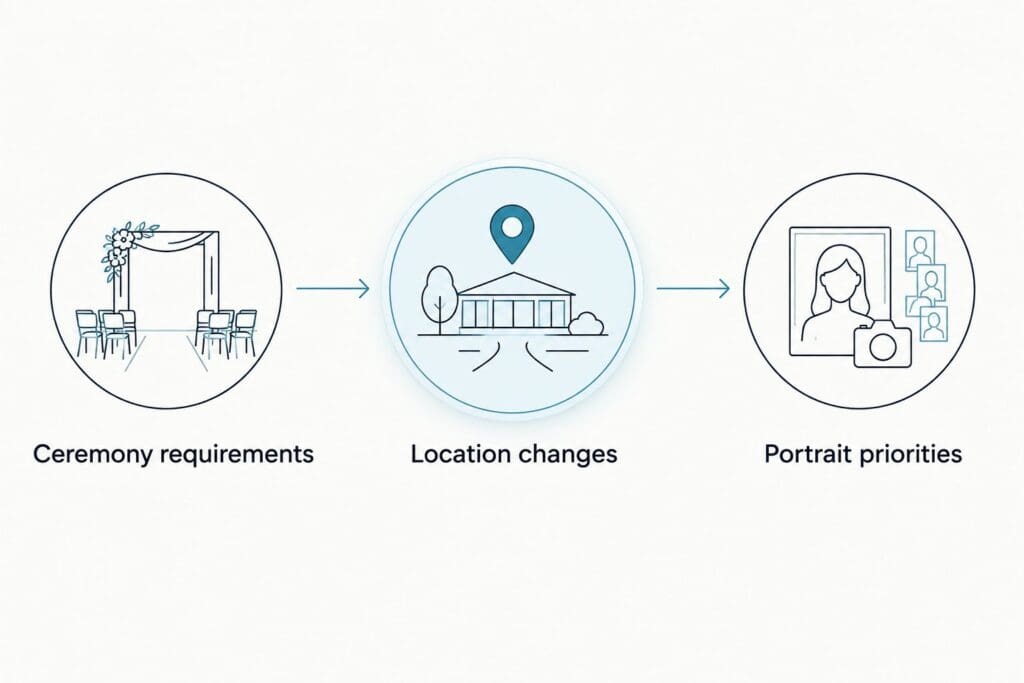
Build the plan around 3 planning checkpoints
I’d check your draft at these 3 planning checkpoints: Ceremony requirements, Location changes, and Portrait priorities. They keep the conversation focused without requiring you to plan every movement of the day.
Each checkpoint answers a different question. What must happen at a fixed time? Where do you need to be? Which photographs deserve a place in the schedule?
Ceremony requirements
Ask your ceremony contact about arrival expectations, photography rules, and when everyone needs to be in place. For a church wedding, ask about photography during the service and whether portraits inside the church are permitted afterward.
Write the answers into the schedule. A restriction that lives only in an email is easy to miss when several people are coordinating the day.
Also identify who can answer a question on the wedding day. Your photographer and coordinator shouldn’t have to guess whom to ask about access or ceremony arrangements.
Location changes
List every move, including getting-ready locations, the ceremony, portrait locations, and the reception. Use the actual addresses when reviewing the route with the people responsible for transportation.
Keep travel separate from photographs. Reaching a location and being ready to take portraits there are not the same task.
If you’re considering an additional portrait stop, ask what it adds and what it displaces. An optional location shouldn’t make a required arrival feel rushed. A location can be lovely and still not belong in your schedule.
Portrait priorities
Tell your photographer which photographs matter most before you discuss a long list of possibilities. Meaningful family traditions, your ceremony, and time together deserve clear attention if those are your priorities.
Separate essential photographs from optional ideas. That distinction gives you a sensible choice if the plan needs adjusting, rather than making every request feel equally urgent.
For couples considering Ephemiamaria, I’d start this conversation with the people and traditions you want included. Then discuss how those priorities fit your ceremony and locations.
Why your wedding photo timeline varies
A sample timeline is a starting point, not a schedule to copy unchanged. Your own plan needs to reflect these details:
- Ceremony arrangements: Required arrival times, photography permissions, and access afterward shape where portraits fit.
- First-look preference: Your choice determines whether couple photographs together can happen before the ceremony.
- Location changes: Separate getting-ready, ceremony, and reception locations create transitions that need their own space.
- Family portrait list: The combinations you request determine which relatives need to gather and stay nearby.
- Meaningful traditions: Include any preparation, ceremony, or reception traditions you want photographed rather than treating them as extras.
- Outdoor portrait plans: Check daylight for your date and location, and agree on an indoor alternative with your venue and photographer.
For a 2026 wedding, confirm the details for your actual date rather than borrowing another couple’s schedule. Their ceremony arrangements and family priorities aren’t yours.
How do we organize family photos without making them complicated?
Create 1 shared family portrait list, then give the same version to the people helping organize photographs. Separate lists with slightly different combinations create unnecessary questions.
Use names, not just relationships. Write out who belongs in each photograph, and flag any family circumstances your photographer needs to handle thoughtfully.
I’d also ask a person who knows your relatives to help identify and gather them. Your photographer can organize the photograph; a familiar face can help find the right people without a guessing game.
Tell those relatives where and when they’re needed before the wedding day. Don’t make the announcement for the first time while everyone is leaving the ceremony.
What should we do if we don’t want a first look?
Compare 2 timeline versions: one with portraits before the ceremony and one with couple portraits afterward. Use that comparison to understand the scheduling trade-off, not to talk yourselves into a moment you don’t want.
If you choose an aisle reveal, decide which photographs can happen separately beforehand and which need both of you together afterward. Then place family photographs, travel, and reception commitments around that decision.
Your preference belongs in the plan. The goal isn’t to find a supposedly perfect schedule; it’s to make your chosen experience workable without pretending the same time can serve several purposes.
How do we leave room for outdoor portraits?
Choose a portrait window with your photographer after checking daylight for the date and location. Don’t copy a sunset time from a different wedding or assume an outdoor location will be accessible when you need it.
Agree on the indoor alternative before finalizing the schedule. Confirm access with the venue, and keep that alternative connected to the rest of your day rather than inventing a new route at the last moment.
If a particular outdoor photograph is optional, say so. Knowing what you can happily leave out is part of making a calm plan.
Frequently Asked Questions
Start your Connecticut wedding photographer timeline with the ceremony, required arrival times, and reception commitments. Add your first-look preference, locations, and portrait priorities before leaving space between transitions.
You don’t need a first look to plan a relaxed wedding day. If you prefer an aisle reveal, give couple portraits together a clear place after the ceremony rather than squeezing them between other commitments.
Place family photos where church permissions, your reveal preference, and family availability allow them. Confirm whether photographs inside the church are permitted after the ceremony before putting that location on the schedule.
Set portrait time with your photographer after sharing your family list, locations, and priorities. A single duration won’t account for those different requirements, and travel needs a separate place in the schedule.
For your 2026 wedding timeline, confirm ceremony requirements, location access, transportation arrangements, and the reception schedule. Check daylight for your specific date if you want outdoor portraits.
Ask Ephe how your ceremony, portrait priorities, and locations fit the photography coverage you’re considering. Request current collection and investment details, and talk about the kind of planning experience you want.
One last thing
Read your timeline as though you’re a guest who has never visited any of the locations. Can you tell where to go, when to leave, and who needs to stay for photographs?
If not, clarify those instructions before adding more detail. A useful timeline doesn’t just say what happens; it helps the right people be there for it. You two get married. The schedule should support that, not compete with it.
Related guides
Leave a Reply

About Ephe
Timeless Photographer

Ephe is based in Connecticut, capturing all of life's most important moments throughout New England. She loves timeless, clean, natural images that are well composed, edited beautifully, and that tell a story. She wants each of her clients to have an unmatched client experience and to get their photos delivered in record time so they can relive their memories right away.
Explore
Recent Posts
Ready to work together?
Whether you're deep in wedding planning, celebrating your senior year, gathering your family together, or simply want to document your current season of life, I'd love to be your photographer! I'm here to help you feel relaxed, capture genuine smiles, and make sure you actually enjoy getting your photos taken.


Leave a Comment